AI Governance Framework: How Enterprises Structure Policies, Roles and Controls
Anil Nair is an enterprise AI strategist focused on AI governance, intelligent automation, agent orchestration, and the architecture required to deploy AI systems safely across complex organizations.

An AI governance framework gives an enterprise one consistent way to approve, control and review every AI system it runs. Without one, each team sets its own rules and risk decisions depend on whoever happens to be in the room.
The need grows as AI moves from pilots into core operations. A claims triage model at an insurer, a supplier risk score at a manufacturer and a resume screening tool in HR carry very different risks. Each one still needs the same questions answered: who approved it, what it can touch and how anyone would know if it went wrong.
What Is an AI Governance Framework?
An AI governance framework is the set of policies, responsibilities and controls that decides how an organization builds, buys, deploys and retires AI systems. It turns broad principles such as fairness and accountability into rules that people and systems follow every day.
A framework is different from a single policy document. A policy states intent, while a framework assigns owners, sets approval paths and defines the evidence each AI system must produce before and after launch.
The Five Core Components of an AI Governance Framework

Every working AI governance framework rests on five components: policies, roles, risk tiers, controls and monitoring. Each one answers a different question and a gap in any of them weakens the rest.
1. Policies and Acceptable Use
An AI governance policy is a written rule set that defines which AI uses are allowed, restricted or prohibited inside the enterprise. It covers data handling, third party models, disclosure to customers and the approval needed before a new use case goes live.
Good policies are short enough to read and specific enough to enforce. A rule that bans customer personal data in external AI tools without a signed data processing agreement can be checked, while a rule to "use AI responsibly" cannot.
2. Roles and Accountability
Roles and accountability define the named people who own each AI system, approve its use and answer for its outcomes. Typical roles include an executive sponsor, a business owner, a risk or compliance reviewer and a technical owner who runs the system.
Together, these roles form the AI governance model of the enterprise. The core principle is that every AI system has one accountable owner by name, so when a lending model starts declining more applications than expected, the team knows who investigates and who can pause it.
3. Risk Tiers
Risk tiers are categories that sort AI systems by potential impact, so oversight scales with risk. A tool that summarizes internal meeting notes does not need the same review as a model that influences credit, hiring or patient care.
A common approach uses three or four tiers, from minimal to high impact. The tier decides the depth of testing, the level of approval and how often the system is reviewed after launch.
4. Controls
Controls are the technical and procedural safeguards that enforce policy on each AI system. They include access restrictions, data protections, testing before release, human approval for sensitive decisions and the ability to pause or roll back a system.
Controls only count when the system enforces them. An approval step that lives in a checklist can be skipped under deadline pressure, while an approval gate built into the workflow cannot.
5. Monitoring and Review
Monitoring is the ongoing measurement of how AI systems behave in production against the expectations set at approval. It tracks accuracy, drift, errors, complaints and incidents and it feeds scheduled reviews by the system owner.
Monitoring closes the gap between the framework on paper and the system in use. A supplier risk model can keep running smoothly while its scores quietly lose accuracy after a market shift, and only monitoring brings that change to light.
How an AI Governance Framework Maps to NIST, ISO 42001 and the EU AI Act
An enterprise AI governance framework usually aligns with three external references: the NIST AI RMF, ISO/IEC 42001 and the EU AI Act. They serve different purposes, so organizations typically use them together rather than choosing one.
| Reference | What It Is | How It Shapes Your Framework |
|---|---|---|
| NIST AI Risk Management Framework | Voluntary US guidance built on four functions: Govern, Map, Measure and Manage | Gives the structure for identifying, measuring and treating AI risk across the lifecycle |
| ISO/IEC 42001 | International standard for AI management systems, certifiable by independent bodies | Provides auditable requirements and a route to third party certification |
| EU AI Act | EU regulation that sorts AI into unacceptable, high, limited and minimal risk | Sets legal obligations that depend on the risk category of each system |
The NIST AI RMF was published in January 2023 as voluntary guidance for organizations that build, buy or operate AI, and it organizes the work into four functions. Govern is the function that spans the whole organization, sitting above Map, Measure and Manage and making them repeatable.
ISO/IEC 42001 was published by ISO and IEC in December 2023 as the first international standard for AI management systems. It certifies the system that governs AI, not any individual model, and certification to it does not by itself establish legal conformity with the EU AI Act.
The EU AI Act entered into force on August 1, 2024, and high risk uses such as AI in recruitment must meet strict requirements that include human oversight. Its provisions apply in stages rather than all at once.
For the source documents, see the NIST AI Risk Management Framework and ISO's overview of ISO/IEC 42001.
How to Build an AI Governance Framework in Six Steps
Building an AI governance framework follows a practical sequence: find what exists, sort it by risk, assign owners, then enforce and review. These AI governance best practices suit an enterprise moving from scattered pilots to governed production use.
- Inventory every AI system in use. Include internal models, vendor tools with AI features and pilots run by individual teams. Shadow AI, meaning tools adopted without central approval, is often the largest gap.
- Classify each system by risk tier. Apply the tiers defined in your policy and record the reason for each decision. Where EU AI Act categories apply, map them to your internal tiers.
- Assign a named owner and approver. Every system gets one accountable owner in the business and one reviewer from risk or compliance.
- Define minimum controls per tier. State what testing, approval and access limits each tier requires before launch.
- Build controls into the workflow. Approval gates, access limits and logging should be enforced by the platform that runs the AI, not by manual checklists.
- Set a review cycle. High risk systems need more frequent reviews, and every incident should trigger a review of the related controls.
Extending the AI Governance Framework to Autonomous AI Agents

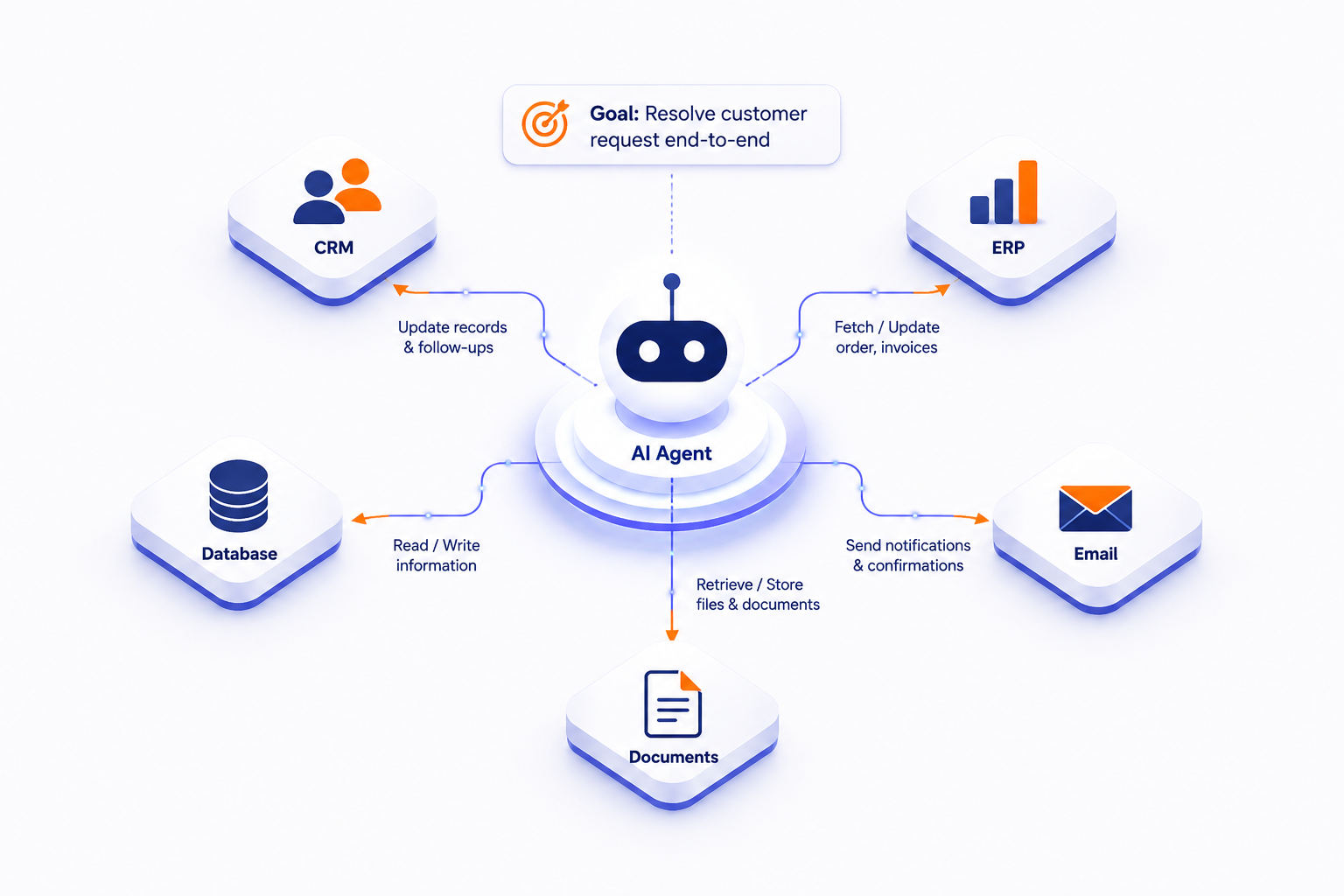
AI agents extend governance from reviewing outputs to controlling actions, because an agent can update records, send messages and trigger transactions on its own. A framework written for models that only produce predictions needs additional controls before agents go live.
Three controls matter most. First, each agent should authenticate with its own scoped identity instead of a shared admin login, so every action traces back to one agent and one owner. Second, read access and write access should be granted separately, per agent and per system, with approval gates on sensitive writes.
Third, authority should grow with evidence. In the AIQoD platform, each agent carries a Dynamic Twin that records its permissions, decision history and confidence, so autonomy expands only as its track record builds, and low confidence actions route to a person for review.
For the agent layer in more depth, see our guides to AI agent identity governance, read and write security for AI agents and AI agent ownership, policies and lifecycle.
Conclusion
An AI governance framework works when it is specific, owned and enforced by the systems that run AI. Policies set intent, named owners carry accountability, risk tiers scale oversight, controls enforce the rules and monitoring shows whether they hold.
External standards provide the structure, but the value comes from applying it to every system in the inventory. Enterprises moving toward autonomous agents gain the most by building these controls into the platform from the start, with people approving the decisions that matter.
Frequently Asked Questions
Is the NIST AI Risk Management Framework mandatory?
No, the NIST AI RMF is voluntary guidance for organizations that build, buy or operate AI. Many enterprises adopt it anyway because it offers a recognized structure for managing AI risk across the lifecycle.
What is the difference between an AI governance framework and ISO/IEC 42001?
An AI governance framework is an organization's own set of policies, roles and controls for AI. ISO/IEC 42001 is an international standard that such a framework can be built to meet and then independently certified against.
Who should own AI governance in an enterprise?
Overall ownership usually sits with a senior executive sponsor supported by a cross functional group from technology, risk, legal and the business. Each individual AI system still needs one named owner who answers for its day to day behavior.