AIQoD Logo
    Back to Blog
    Agentic AI
    September 3, 2026

    Agentic AI Statistics 2026: Adoption, ROI & Market Size
    NL

    Nagavardhan Lella

    Connect on LinkedIn
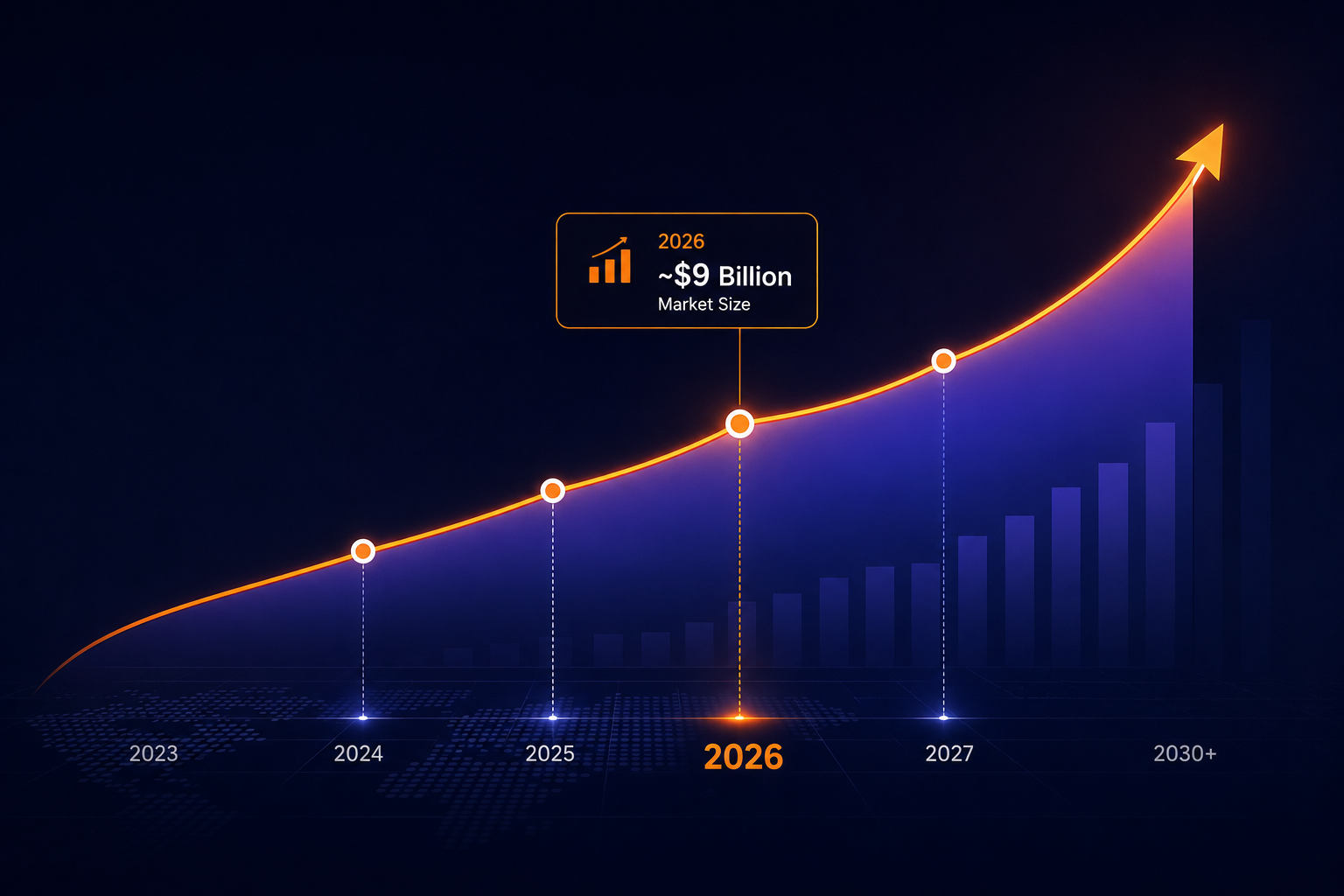
    Agentic AI market growth curve rising through 2026
    The agentic AI market is worth roughly $9 billion in 2026 and growing more than 40% a year.

    Agentic AI is growing about as fast as any technology enterprises have adopted and stalling before production more often than almost any other. Both things are true at once and that tension is the real story hiding inside this year's numbers.

    The headline figures are big. The market sits at roughly $9 billion in 2026, Gartner expects 40% of enterprise applications to have task-specific agents built in by year-end and analysts see the market growing more than 40% a year for the rest of the decade. But adoption isn't the same as production and the gap between them is where most of the interesting data lives.

    How big is the market in 2026?

    The agentic AI market is worth roughly $9 billion this year, up from about $7 billion in 2025, and it's forecast to keep growing at more than 40% a year. Longer-range projections are messier, mostly because different studies measure different things agent software alone versus total AI spend, so the numbers don't always line up.

    What's measuredFigureSource
    Market size, 2026~$9 billionMordor, Fortune Business Insights
    Projected market, 2034~$139 billionFortune Business Insights
    Enterprise app revenue from agents, 2035~$450 billion (≈30% of total)Gartner
    Overall AI spending by 2029$1.3 trillion (31.9% CAGR)IDC

    Even the cautious estimates describe one of the steepest climbs enterprise software has seen.

    How many companies are actually using it?

    Lots of interest, not much production yet that's the shape of it.
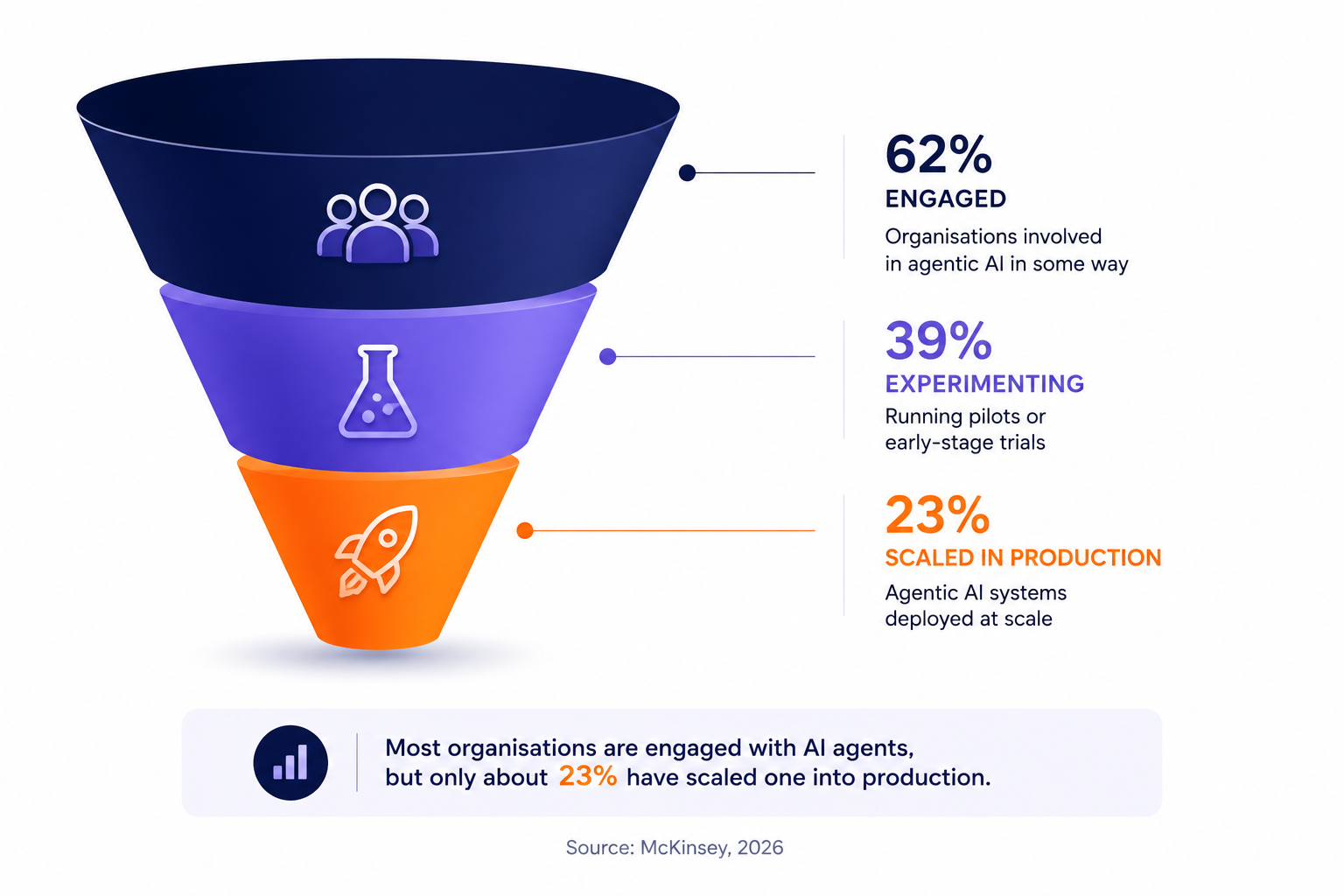
    Adoption funnel: 62% engaged, 39% experimenting, 23% in production
    Adoption funnel: 62% engaged, 39% experimenting, 23% in production

    McKinsey finds about 23% of organisations have scaled an agentic system into production, while 39% are still experimenting and 62% are involved in some way. A few more markers worth knowing:

    • 40% of enterprise apps will embed task-specific agents by the end of 2026, versus under 5% in 2025 (Gartner).
    • 88% of organisations now use AI regularly in at least one function, up from 78% the year before (McKinsey).
    • 40% of roles in Global 2000 companies will deal directly with AI agents by the end of 2026 (IDC).
    • Deloitte expects the share of gen-AI companies running agentic pilots to jump from 25% in 2025 to 50% by 2027.

    The pattern holds across every survey: almost everyone's interested, but reaching production is still the exception.

    What kind of returns are companies seeing?

    Real, but wildly uneven.
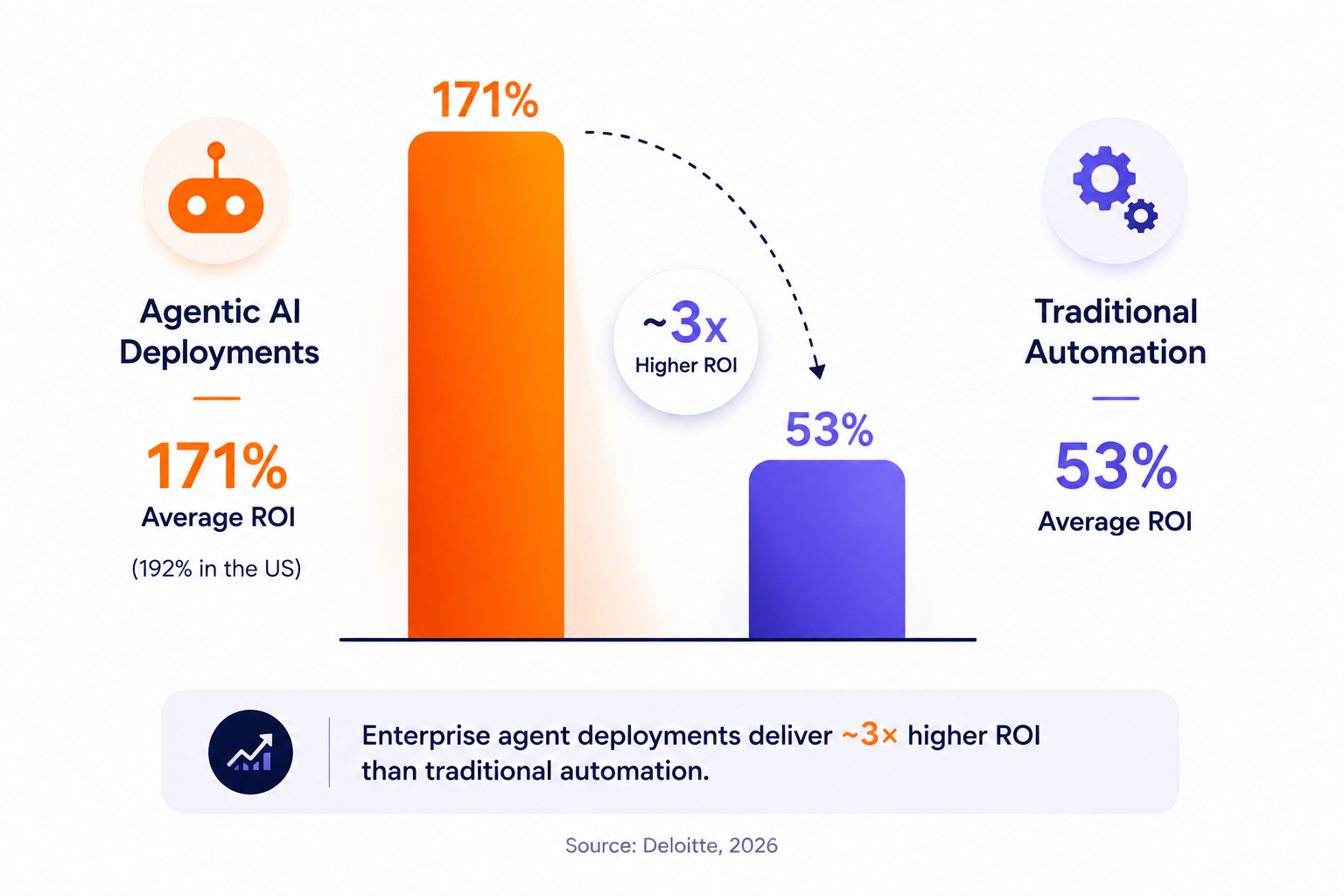
    Agentic AI ROI shown at about three times traditional automation
    Agentic AI ROI shown at about three times traditional automation

    Deloitte's 2026 report puts the average return on enterprise agent deployments at 171% and 192% in the US roughly three times what traditional rule-based automation returns. Generative AI more broadly earns back about $3.70 for every $1 spent (IDC and Microsoft).

    That average is doing a lot of heavy lifting, though. A small group of strong performers pulls it up while plenty of others see very little. IBM's CEO study found only 25% of AI initiatives delivered the ROI companies expected. The gap between the two groups almost never comes down to technology, it comes down to whether anyone defined and measured success from the start.

    What we see in our own deployments

    Analyst averages are useful, but our own numbers tell the same story from the inside. Across the enterprises AIQoD works with, the results cluster in the same place the research points to. One client reduced a document heavy operation from hours to minutes, another cut the manual effort on a repetitive process by the equivalent of several working days each week, and several report sharply lower manual workload while pushing accuracy close to 100 percent. The pattern behind those figures is consistent, the gains come fastest on high volume, repeatable work, which is exactly where the market data says the value is concentrated.

    Why do so many projects fail?

    Here's the number everyone quotes: Gartner expects more than 40% of agentic AI projects to be cancelled by the end of 2027, mostly because of unclear value, runaway costs and weak controls. And when you look at why, the causes are almost all foundational rather than technical. Data quality comes up again and again as the biggest blocker. Only about a third of organisations have a mature way to govern autonomous agents. And a lot of projects launch with no baseline metrics at all, so their results look ambiguous and ambiguous is what gets a budget cut.

    Where it's heading

    The single-purpose agent is already on its way out. Gartner expects that by 2027, a third of agentic implementations will use several specialised agents working together one qualifying a lead, another drafting outreach, a third checking compliance, all sharing context and passing work along without a human in between. That move toward multi-agent orchestration is exactly why analysts keep calling 2026 the year agents crossed from experiment to infrastructure.

    What the 2026 data tells us

    The 2026 data tells one story from two directions: agentic AI is scaling faster than almost anything before it, and most early projects still don't reach production. The companies pulling ahead aren't the ones spending the most — they're the ones with clean data, real governance, and a business case they can actually measure.

    A few common questions

    1. Where do agentic AI statistics come from?

    Most credible figures trace back to a handful of research firms, mainly Gartner, McKinsey, IDC and Deloitte, along with market sizing studies. When you see an agentic AI number quoted online, it's worth checking which of these it originates from, since the quality and scope vary widely.

    2. Why do agentic AI market size estimates vary so much?

    Because studies measure different things. Some count only agent software, others include the wider AI infrastructure and services around it and a few fold in adjacent automation spend. That's why one report says nine billion and another says something far larger, they aren't measuring the same boundary.

    3. How does agentic AI adoption in 2026 compare to 2025?

    The jump is steep. The share of enterprise applications with agents built in is set to climb from under 5 percent to around 40 percent in a single year, and the number of organisations moving from experiments to production is rising alongside it. 2026 is widely described as the year agents crossed from pilots into real infrastructure.

    4. Are these statistics based on surveys or real deployments?

    A mix of both, and it matters. Adoption and ROI figures often come from self reported surveys, which can run optimistic, while market size comes from financial modelling. Treat survey based numbers as directional rather than exact and weigh them against real deployment outcomes where you can find them.

    Related Articles

    AI Agent Lifecycle Management: How Enterprises Run Agents From Build to Retirement

    AI Agent Lifecycle Management: How Enterprises Run Agents From Build to Retirement

    AI agent lifecycle management is the practice of controlling an agent through seven stages, from definition and build to evaluation, deployment, operation, improvement and retirement. Each stage ends in a decision that someone named has to make, backed by evidence, which is what keeps an agent estate governed as it grows.

    Read Article
    AI Agent Observability: How Enterprises Monitor AI Agents in Production

    AI Agent Observability: How Enterprises Monitor AI Agents in Production

    AI agent observability is the practice of recording and reviewing what agents do in production, covering task outcomes, tool calls, policy events, escalations and cost. It exists so an organization can tell whether an agent still behaves the way it did when it passed evaluation, and act before a small drift becomes a business incident.

    Read Article
    AI Agent Evaluation: How Enterprises Test and Validate Agents Before Production

    AI Agent Evaluation: How Enterprises Test and Validate Agents Before Production

    AI agent evaluation measures whether an agent completes real business tasks correctly, follows policy and escalates when it should. It judges the sequence of actions an agent takes, not only its final answer, and it works as the gate that decides whether an agent is allowed into production and stays there after every change.

    Read Article
    Human in the Loop AI: How Enterprises Design Approval and Escalation for AI Agents

    Human in the Loop AI: How Enterprises Design Approval and Escalation for AI Agents

    In human in the loop AI, people approve, correct or stop AI actions at decision points the business defines in advance. For AI agents, that means routing irreversible, low confidence and out of policy actions to a named approver, letting routine work run under monitoring and treating every approval as feedback that corrects the agent, so autonomy widens once its confidence is calibrated and its record is proven.

    Read Article
    How to Evaluate an Enterprise AI Platform: Criteria for CIOs and Architects

    How to Evaluate an Enterprise AI Platform: Criteria for CIOs and Architects

    Choosing an enterprise AI platform comes down to seven checks: governance enforced at runtime, scoped identity and access, deployment flexibility, integration depth, model flexibility, lifecycle operations and total cost. Testing each platform on one real process shows more than any feature list.

    Read Article
    AI Governance Framework: How Enterprises Structure Policies, Roles and Controls

    AI Governance Framework: How Enterprises Structure Policies, Roles and Controls

    An AI governance framework is the operating structure an enterprise uses to decide how AI is approved, controlled and monitored. It combines written policies, named owners, risk tiers, technical controls and ongoing monitoring, commonly aligned with the NIST AI RMF, ISO/IEC 42001 and the EU AI Act.

    Read Article
    AI Agent Orchestration: How Enterprises Coordinate Multi Agent Workflows

    AI Agent Orchestration: How Enterprises Coordinate Multi Agent Workflows

    AI Agent Orchestration coordinates specialized AI agents across enterprise workflows by managing task routing, delegation, communication, context transfer and workflow state, so the right agent handles each task and complex processes remain observable and accountable.

    Read Article
    Read and Write Security for AI Agents: Controlling Enterprise Actions

    Read and Write Security for AI Agents: Controlling Enterprise Actions

    Read and Write Security for AI Agents defines how enterprises control the information agents can retrieve and the changes they can make across business systems, separating read permissions from write permissions, limiting tool access, enforcing approval gates and recording every important action.

    Read Article
    AI Agent Governance: How Enterprises Manage Agent Ownership, Policies, and Lifecycle

    AI Agent Governance: How Enterprises Manage Agent Ownership, Policies, and Lifecycle

    AI Agent Governance defines how enterprises establish accountability, ownership, policies, and lifecycle controls for AI agents, so organizations can manage agent adoption while maintaining oversight, consistency, and accountability.

    Read Article
    AI Agent Identity Governance: The Enterprise Shift From Access to Accountability

    AI Agent Identity Governance: The Enterprise Shift From Access to Accountability

    AI agent identity governance is becoming a core enterprise requirement as autonomous agents gain access to business systems and data. Organizations now need to identify agents, define their permissions, assign accountable human sponsors, monitor activity and manage access throughout the agent lifecycle.

    Read Article
    Enterprise Intelligence Layer: The Architecture Behind Governed Enterprise AI

    Enterprise Intelligence Layer: The Architecture Behind Governed Enterprise AI

    An Enterprise Intelligence Layer connects enterprise data, business context, AI agents, workflows, governance, and human oversight into a shared operating foundation, instead of every AI system recreating context and controls on its own.

    Read Article
    What Is Agentic AI? The Complete Enterprise Guide (2026)

    What Is Agentic AI? The Complete Enterprise Guide (2026)

    Agentic AI is software that pursues goals and completes multi-step tasks on its own. Learn how it works, how it differs from generative AI, and enterprise uses.

    Read Article
    After Two Days at Google, I Realized Most Companies Are Not Ready for What's Coming in AI

    After Two Days at Google, I Realized Most Companies Are Not Ready for What's Coming in AI

    Discover key insights from the Google Mountain View AI conference. Learn why agentic AI, context-driven systems, and operational intelligence are the future of enterprise software.

    Read Article

    Ready to Implement Agentic AI?

    Transform your enterprise with AIQoD's autonomous agents. Experience the future of agentic execution today.